 TacticScale
Value Investing
The Bond Hiding Inside Every Stock
A stock is just a bond with the coupon set free — the same cash-flow math, with the one fixed number allowed to grow, compound, or vanish.
Buy a bond and the whole deal is written down before you sign: a fixed coupon each year, your principal back on a stated date, on a schedule you can read in advance. Buy a stock and you’ve bought the same kind of thing — a claim on a stream of future cash — except almost nothing about that stream is written down. The coupon floats. It can grow, compound, shrink, or stop altogether. That single difference is, more or less, the whole of equity investing.
It’s worth starting from the bond, because the bond is the honest version — the machine with the uncertainty switched off. Once you can see it there, you can see it inside every stock.
A bond is the machine, simplified
What is a bond worth? Add up the cash it will pay you — each coupon, plus the principal at the end — and shrink every future payment back to today, because a dollar next year is worth less than a dollar now. The rate you shrink by is the return you require. That’s it: value is the sum of future cash, discounted. Everything you need is on the page, so the only real variable is the rate — which is why a bond’s price moves almost mechanically against interest rates. Rates up, the fixed coupons are worth less today, price down. Rates down, price up.
A bond, in other words, is a discounted-cash-flow calculation you can trust, because its cash flows are a contract. Hold onto that picture. A stock is the exact same calculation — with one input released from its contract.
A stock is a bond with the coupon set free
The “coupon” of a stock is the cash the business throws off for its owners each year — its free cash flow, its owner earnings. But where a bond’s coupon is fixed, printed, and senior, a stock’s is none of those things:
It is variable — it can rise or fall with the business. It can compound — cash reinvested at a good return produces more cash next year, the engine behind equities’ enormous long-run returns. It is junior — shareholders are paid last, after lenders and suppliers and tax. And it has no maturity — a company doesn’t “come due”; it’s a perpetuity, so there’s no principal repayment at the end, just coupons stretching out forever.
This is not a metaphor. It’s the literal structure, and it’s how the best investors actually think. Buffett has said it plainly: a stock is just a bond with a variable coupon, and the analyst’s whole job is to figure out what those coupons are going to be. Value them exactly as you’d value a bond — then do the hard part, which is guessing the coupon.
A bond tells you its coupon. A stock makes you guess it — and pays you for being right.
What setting the coupon free actually changes
Three things follow from that one change, and they explain almost everything about how stocks behave.
One: you should demand more. Because the coupon is uncertain and paid last, you require a higher return from a stock than from a safe bond — the “equity risk premium.” Same arithmetic, bigger discount rate. The riskier and more junior the cash, the higher the rate, the less you should pay.
Two: growth can create value — but only sometimes. A reinvested coupon compounds, and that’s where the big money is. But reinvestment only adds value when the company earns more on that cash than you require — when it has a genuine edge, a moat. Growth without an edge just recycles cash at the going rate; it moves the number up and the cost up by the same amount, and creates nothing. “Growing” and “valuable” are not the same word.
Three: the clock never runs out. With no maturity, most of a stock’s value sits far in the future — the long tail of coupons, the “terminal value.” That makes stocks long-duration, and long-duration things are exquisitely sensitive to the rate. Raise your required return a point and the distant coupons wither first; the near ones barely move. It’s the same reason a 30-year bond swings more than a 2-year one when rates shift — a stock is the longest bond there is.
The bond view as discipline
Reading a stock as a bond isn’t just tidy; it hands you three questions that keep you honest.
“What yield am I being offered?” Don’t only guess a value and compare it to price. Invert the math: at today’s price, what return is the market pricing into this stream of coupons? That’s a yield-to-price for a stock — and it turns a vague “looks cheap” into a number you can judge.
“What do I get if the coupon never grows?” Strip the growth out and value the current cash as a flat, forever coupon. That is the bond-like skeleton hiding inside the stock — its no-growth floor. If today’s price is barely above it, you’re essentially buying the bond and getting the growth thrown in. If the price is far above it, then nearly your entire thesis is the coupon growing — and you’d better be right about the moat.
“Am I paying a safe price?” Margin of safety is the equity version of not overpaying for a bond: buy the variable coupon cheap enough that even a disappointing coupon still pays you a decent return. You can’t make an uncertain coupon certain — but you can refuse to pay a certain price for it.
Why the bond keeps you humble
The same lens that promises compounding also issues the warning. A world of higher rates marks down long-duration equity the hardest — your discount rate is the whole ballgame for a perpetuity. And unlike a contract, this coupon can simply be cut: demand fades, a moat cracks, the cash shrinks. The upside and the fragility come from the same fact — the coupon is free. An investor’s job is to buy that freedom at a price where it can only help.
A worked pair: a quality stock and a plain bond
Make it concrete. Put a wide-moat compounder — think of a steady consumer business like Coca-Cola, the kind Buffett calls a bond with a growing coupon — next to a plain, safe bond yielding about 5%. The bond’s deal never changes: 5% a year, your money back, low risk. The stock’s deal changes with its price.
The honest way to compare them is in the same unit — an annual return. A stock’s offered return at a given price is roughly its cash yield (owner earnings ÷ price) plus the growth you can actually count on. Pay less, and that offered return is high; pay more for the same coupons, and it falls. So draw it against the bond’s flat line:
This is the whole discipline in one picture. The question is never “is this a great company?” — it usually is. It’s “at this price, does the stock’s offered return clear the bond by enough to pay me for the uncertainty I’m taking on?” When a quality name runs up, its offered return can quietly sink below a boring bond’s, and the patient move is to own the bond and wait. When fear knocks the price down, the stock’s return vaults back over the line, and that is the good entrance — you collect a bond-beating yield now, with the growing coupon thrown in for free.
Coca-Cola today, against a ~5% bond
Here is that exact comparison, live on TacticScale. Coca-Cola (KO) is the archetype — the wide-moat compounder Buffett has held for decades, the original “bond with a growing coupon.”
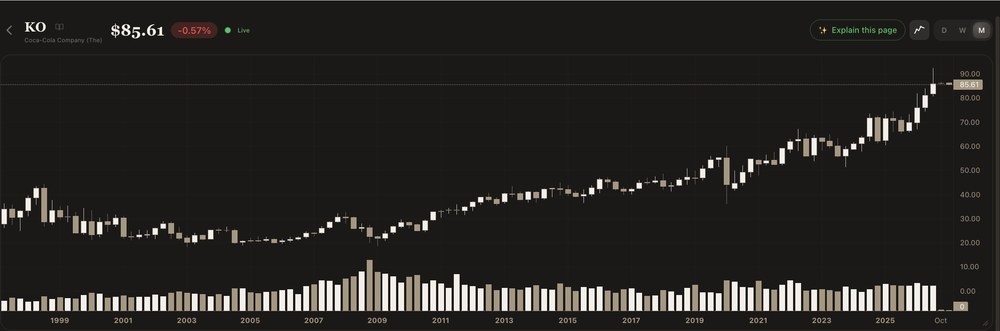
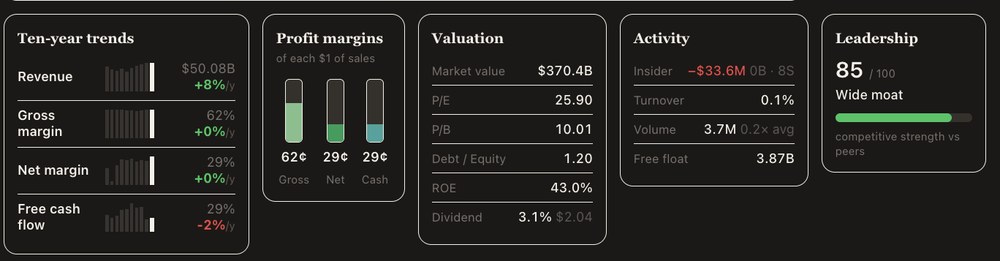
Start with the engine behind the coupon:
Now put it next to today’s bond — a 10-year Treasury yielding roughly 5%, safe and fixed. At about $86 a share, TacticScale’s model places KO’s fair value near $77, inside a bear-to-bull range of $54–$150 — so the price sits just above the base case: fairly priced, no edge.
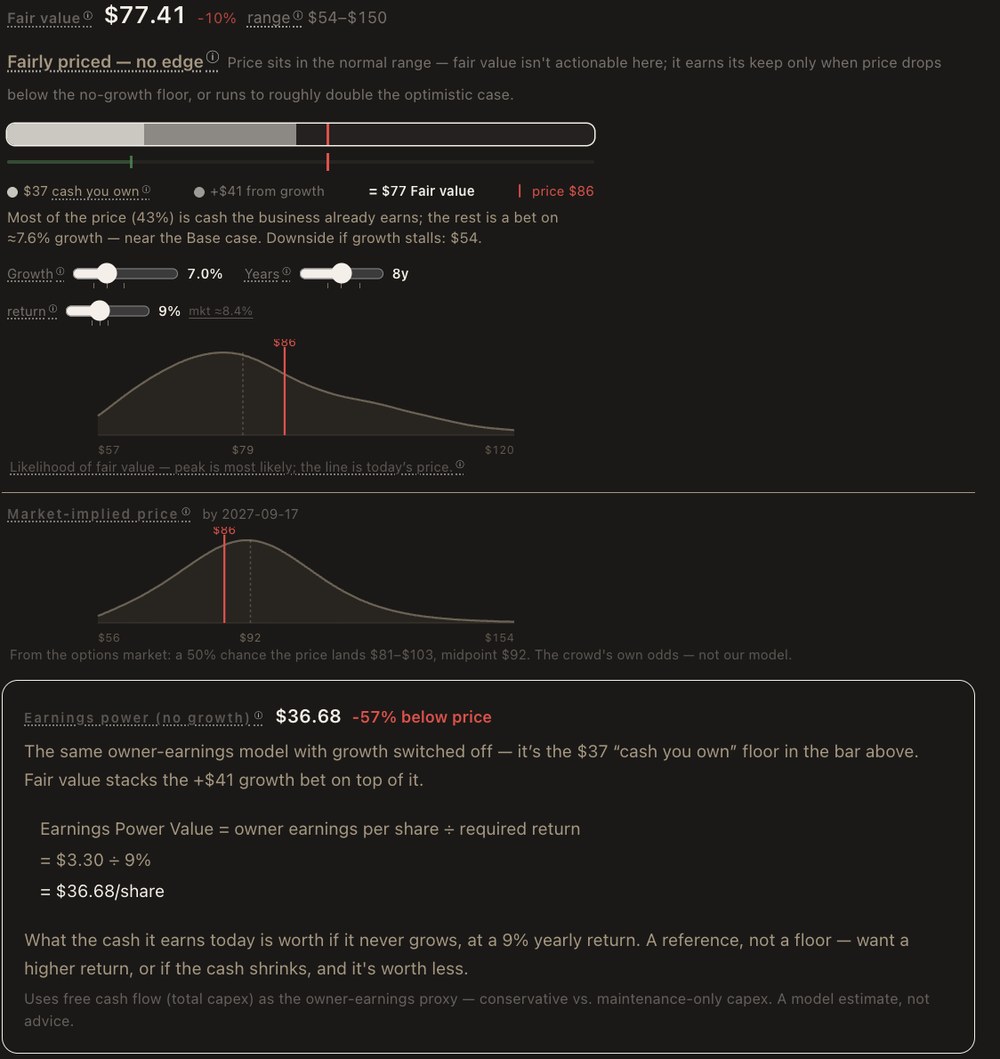
Read as a bond, the comparison is sharp. KO’s owner-earnings yield is only about 3.8% (roughly $3.30 of owner earnings on an $86 price), and its dividend 3.1% — both well below the ~5% you can get risk-free from the Treasury. On day-one cash, the safe bond pays you more. KO’s entire case is the coupon growing: switch growth off and the no-growth floor is just $37 — so more than half of today’s price (~57%) is a bet on future growth, where a bond’s price is almost none.
So what are you actually offered? Add that ~3.8% starting yield to Coke’s durable ~7% growth and you arrive near the ~8.4% annual return the market is implying at this price — about a three-point premium over the ~5% bond. That’s modest pay for equity risk on a wide-moat compounder, but it isn’t a gift, and the whole premium leans on the coupon compounding as expected. “No edge” is the honest word.
When the bond wins. Two ways. If KO ran higher while its growth outlook didn’t, its offered return would sink toward the bond’s — you’d be paying up for growth the price already assumes. Or if yields rose further — the 10-year pushing toward 6% — the guaranteed bond would close the gap, and, because a stock is the longest-duration bond there is, that same higher rate would mark KO’s fair value down at the very moment the bond got more attractive.
The good entrance. If fear knocked KO toward its bear case (~$54), or further toward its no-growth floor (~$37), the starting yield would vault well above the bond, the 7% growth would become a free option on top, and the margin of safety — the gap between the two yields, in your favour — would finally be real. That is the moment the bond hiding inside the stock goes on sale, and it’s exactly the moment this view is built to catch.
How TacticScale shows the bond inside the stock
The KO view above isn’t a special case — every company is laid out the same way, valued as a bond first, with the point where the coupon was set free made explicit.
The coupon is named. The model starts from owner earnings — the cash the business hands its owners — and treats it as the coupon in a discounted cash flow. One uniform calculation for every company; no story required to get the number.
You set the yield you demand. A required-return slider is the discount rate — your hurdle. And a market-implied marker reads the other direction: at today’s price, what return is the market actually pricing into this stock? It’s a bond’s yield-to-price, for an equity.
The bond-like floor is drawn for you. The no-growth floor (Earnings Power Value) is the coupon valued as a flat perpetuity — the skeleton bond. The bar makes the split literal: how much of the price is that floor you own outright, and how much is the bet on growth you haven’t seen yet.
The math is shown plainly. Tap any term for a plain-language explainer, including the DCF formula itself — V = CF₁∕(1+r) + CF₂∕(1+r)² + …, the identical equation that prices a bond, with the coupon let loose. A little concept map links owner earnings, required return, the no-growth floor and the rest together.
And the crowd’s coupon, too. For liquid names, an options-implied curve reads the market’s own probability distribution for the price — the collective bet of everyone trading the stock, straight off the option chain, no model required.
See the bond inside any stock → A model estimate, not advice — the decision stays yours.
This essay is for education and general discussion. It is not investment advice, and nothing here is a recommendation to buy or sell any security. Companies are mentioned only to illustrate ideas. Do your own research; the decisions are yours.
价值投资
每只股票里都藏着一张债券
股票不过是一张把票息放开了的债券——同样的现金流算术,只是那个唯一固定的数字被允许增长、复利,或归零。
买一张债券,整笔交易在您签字之前就已白纸黑字写定:每年固定的票息、在约定日期归还的本金,一切都按一张您事先就能读懂的时间表进行。买一只股票,您买到的是同一类东西——对一串未来现金的索取权——只不过这串现金几乎没有任何一项是写定的。票息是浮动的。它可以增长、复利、萎缩,或干脆停发。而这一个区别,大体上,就是股权投资的全部。
不妨从债券讲起,因为债券是诚实的版本——一台把不确定性关掉了的机器。一旦您能在债券里看清它,就能在每一只股票里看见它。
债券:这台机器的简化版
一张债券值多少?把它将支付给您的现金加起来——每一期票息,加上到期的本金——再把每一笔未来的支付折算回今天,因为明年的一块钱不如今天的一块钱值钱。您用来折算的比率,就是您所要求的回报率。就这么简单:价值等于未来现金的折现之和。所需的一切都写在纸上,于是唯一真正的变量就是那个比率——这也是为什么债券的价格几乎是机械地随利率反向波动。利率上行,固定的票息在今天就更不值钱,价格下跌;利率下行,价格上涨。
换句话说,债券是一笔您可以信赖的现金流折现(DCF)计算,因为它的现金流是一纸合约。请记住这幅图景。股票,就是完全相同的那笔计算——只是其中一个输入项挣脱了合约的束缚。
股票:一张把票息放开了的债券
股票的「票息」,就是企业每年为其股东创造出的现金——它的自由现金流,它的所有者收益。但债券的票息是固定的、印在纸上的、清偿顺序靠前的,而股票的票息则样样都不是:
它是可变的——会随企业而起落。它能复利——以不错回报率再投资的现金,明年会生出更多现金,这正是股权能带来巨大长期回报的引擎。它的清偿顺序靠后——股东排在最后受偿,位于放贷人、供应商与税收之后。它没有到期日——公司不会「到期」;它是一笔永续年金,因此末尾没有本金偿还,只有无穷延伸下去的票息。
这并非比喻。它就是字面意义上的结构,也是最优秀的投资者真实的思考方式。巴菲特说得很直白:股票不过是一张带可变票息的债券,而分析师的全部工作,就是弄清这些票息将会是多少。像给债券估值那样精确地给它估值——然后去做最难的那部分:猜出票息。
债券会告诉您它的票息。股票却逼您去猜——并在您猜对时给您回报。
放开票息,究竟改变了什么
这一个改变带来三个推论,几乎解释了股票的全部行为。
其一:您应当要求更多。由于票息不确定、且受偿顺序靠后,您对股票所要求的回报要高于对一张安全债券的要求——这就是「股权风险溢价」。同样的算术,更大的折现率。现金越有风险、清偿顺序越靠后,折现率越高,您就越不该多付。
其二:增长能够创造价值——但仅在某些时候。再投资的票息会复利,大钱正藏在这里。但只有当公司在那笔现金上赚到的回报高于您的要求时——也就是它拥有真正的优势、一条护城河——再投资才会增添价值。没有优势的增长,只是在以市场通行的回报率空转现金;它把数字抬高,也把成本抬高同样的幅度,什么也没创造出来。「在增长」和「有价值」并不是同一个词。
其三:这台时钟永不停摆。由于没有到期日,一只股票的大部分价值都坐落在遥远的未来——那条票息的长尾,即「终值」。这使股票成为长久期资产,而长久期的东西对折现率极其敏感。把您要求的回报率上调一个百分点,最远处的票息首当其冲地枯萎;近处的几乎纹丝不动。这与 30 年期债券在利率变动时比 2 年期波动更大是同一个道理——而股票,是世上久期最长的那张债券。
以债券视角作为纪律
把股票读作债券,不只是图个整洁;它还递给您三个让您保持诚实的问题。
「我被提供的是多大的收益率?」不要只是猜一个价值、再拿它跟价格比。把算术反过来:按今天的价格,市场为这串票息定价进去的回报率是多少?这就是股票的「价格对应收益率」——它把含糊的「看起来便宜」变成一个您可以判断的数字。
「如果票息永不增长,我能得到什么?」把增长剥掉,把当前现金当作一笔平直、永续的票息来估值。这就是藏在股票内部那副债券般的骨架——它的无增长底价。如果今天的价格仅略高于它,您本质上是在买那张债券、而把增长白送了进来。如果价格远高于它,那么您几乎整个论点都押在票息会增长之上——您最好对护城河看得没错。
「我付的是不是一个安全的价格?」安全边际,就是「不为债券付过高价」在股权上的对应:把这张可变票息买得足够便宜,使得即便票息令人失望,仍能给您一个尚可的回报。您无法把不确定的票息变确定——但您可以拒绝为它付一个确定的高价。
为什么债券视角让您保持谦卑
那面许诺复利的透镜,同时也发出警告。利率更高的世界,对长久期股权的折价最狠——对一笔永续年金而言,您的折现率就是全部胜负手。而且,不同于一纸合约,这张票息可以被直接削减:需求退潮、护城河开裂、现金萎缩。上行空间与脆弱,源自同一个事实——票息是自由的。投资者的工作,是在一个「它只会帮到您」的价格上,买下这份自由。
一组实例对照:一只优质股票与一张普通债券
把它讲具体些。把一个拥有宽阔护城河的复利机器——想想像可口可乐这样稳健的消费企业,巴菲特口中那张「带增长票息的债券」——摆在一张收益率约 5%、普通而安全的债券旁边。债券的交易条件永不改变:每年 5%、归还本金、风险很低。股票的交易条件则随其价格而变。
诚实的比较方式,是把二者放进同一个单位——年化回报。股票在某个价格上的所提供的回报,大致等于它的现金收益率(所有者收益 ÷ 价格)加上您真正能指望的增长。付得越少,这个所提供的回报越高;为同样的票息付得越多,它就越低。那么,把它画在债券那条平直的水平线旁边:
整套纪律尽在这一幅图里。问题从来不是「这是不是一家伟大的公司?」——它通常是。问题是「在这个价格上,股票所提供的回报,是否足够高过债券,以补偿我所承担的不确定性?」当一只优质股票被买高,它所提供的回报会悄悄沉到一张乏味债券之下,而耐心的做法,是持有债券、静待。当恐慌把价格打下来,股票的回报重新跃回线上——那才是好的买入点:您当下就收取一个跑赢债券的收益率,而那张会增长的票息还免费附送。
今天的可口可乐,对阵一张约 5% 的债券
下面就是这组完全相同的对照,在 TacticScale 上实时呈现。可口可乐(KO)是那个原型——巴菲特持有了数十年的宽护城河复利机器,最初那张「带增长票息的债券」。
先看票息背后的引擎:
现在把它摆到今天的债券旁边——一张收益率约 5%、安全而固定的 10 年期美国国债。在每股约 86 美元处,TacticScale 的模型把 KO 的公允价值估在约 77 美元,位于 54–150 美元的熊市至牛市区间内——因此价格恰好略高于基准情形:价格合理,无明显优势。
读作债券,这组对比十分鲜明。KO 的所有者收益率只有约 3.8%(在 86 美元价格上约合 3.30 美元的所有者收益),股息率 3.1%——两者都远低于您能从国债上无风险取得的约 5%。就第一天的现金而言,安全的债券付给您更多。KO 的全部理由都在于票息增长:把增长关掉,无增长底价仅为 37 美元——也就是说,今天价格的一半以上(约 57%)是对未来增长的押注,而债券的价格里几乎没有这一块。
那么您实际被提供的是什么?把约 3.8% 的起始收益率,加上可乐持久的约 7% 增长,您便来到市场在此价格上所隐含的 约 8.4% 年化回报附近——比约 5% 的债券高出约三个百分点。对一个宽护城河复利机器而言,这是为股权风险支付的微薄报酬,但也并非白送,而且这整段溢价都倚赖票息如预期般复利。「无明显优势」才是诚实的说法。
债券何时胜出。有两种情形。其一,若 KO 价格走高、而增长前景并未同步改善,它所提供的回报就会向债券沉降——您是在为价格早已假定的增长多付钱。其二,若收益率进一步上行——10 年期逼近 6%——有保障的债券会缩小差距;而且,由于股票是久期最长的那张债券,同样这个更高的利率会在债券恰好变得更有吸引力的那一刻,把 KO 的公允价值向下折算。
好的买入点。若恐慌把 KO 打向它的熊市情形(约 54 美元),或更进一步逼近它的无增长底价(约 37 美元),起始收益率便会大幅跃上债券之上,那 7% 的增长会变成额外的免费期权,而安全边际——两个收益率之间、对您有利的那段差距——才终于成真。那一刻,藏在股票内部的那张债券正在打折出售,而这套视角,正是为捕捉那一刻而生。
TacticScale 如何呈现股票里的那张债券
上面的 KO 视图并非特例——每一家公司都以同样的方式铺陈开来:先当作债券估值,并把「票息被放开」的那一点明确标出。
票息被点名。模型从所有者收益出发——企业交到股东手上的现金——并把它当作现金流折现(DCF)里的票息。对每一家公司采用同一套统一计算;无需任何故事就能得出数字。
您设定自己要求的收益率。一个「要求回报率」滑块就是折现率——您的门槛。另有一个市场隐含标记从反方向读出:按今天的价格,市场实际为这只股票定价进去的回报是多少?这就是股权版的债券「价格对应收益率」。
那条债券般的底价已为您画出。无增长底价(盈利能力价值,EPV)就是把票息当作一笔平直永续年金估出的值——那副骨架债券。价格条把这一拆分变得可见:价格里有多少是您完全拥有的那个底价,又有多少是对您尚未见到的增长的押注。
算术被摊开讲明。点按任意术语即可看到通俗解释,包括现金流折现(DCF)公式本身——V = CF₁∕(1+r) + CF₂∕(1+r)² + …——与给债券定价的方程式完全相同,只是把票息放开了。一张小小的概念图,把所有者收益、要求回报率、无增长底价等连在一起。
还有大众给出的那张票息。对流动性好的标的,一条期权隐含曲线读出市场自身对价格的概率分布——所有交易这只股票的人的集体押注,直接取自期权链,无需任何模型。
看见任意股票里的那张债券 → 这是模型测算,而非投资建议——决定权始终在您。
本文用于教育与一般性探讨,不构成投资建议,文中任何内容都不是买入或卖出任何证券的推荐。提及公司仅为阐明观点。请自行研究,决定由您自己作出。