 TacticScale
Value Investing
Are We All Just Speculators?
On fair value, cash, and the quiet line between owning a business and betting on a price.
Open any investing app and one number never sits still: the price. It updates every second, in the collective best effort of millions of people trying to say what a company is worth right now. Against that live, humming figure, “fair value” can look almost quaint — a slow estimate, recomputed each quarter from earnings, growth, and a discount rate that all keep moving too.
So here is a fair and uncomfortable question. If fair value is a moving estimate, and price is a faster, more liquid estimate, isn’t fair value just a laggier version of the same thing? And if so — is Warren Buffett really any different from a trader? Is there even such a thing as a “value investor,” or are we all just speculators with nicer vocabularies?
It’s worth taking seriously, because half of it is exactly right.
Fair value is an estimate, not a target
Any honest valuation is a range, not a single true number the market is too dim to see. It depends on assumptions — how fast a company grows, for how long, what you demand in return — and reasonable people will land in different places. Anyone who tells you they’ve computed the one correct price is selling certainty that doesn’t exist. So yes: fair value is a moving, uncertain estimate. Concede the point.
But “both move” quietly smuggles in a false equivalence. The line between investing and speculating was never value is fixed, price moves. It’s two other things entirely.
Where your return comes from
A speculator’s profit comes from the next buyer paying more. The return is someone else’s future opinion. An investor’s return comes from the business’s cash — earnings paid out as dividends, shares quietly bought back, cash reinvested to compound. That distinction isn’t a mood; it’s a mechanism.
Here’s the cleanest way to see it. Take a company’s current cash generation and assume it never grows a cent — just capitalize it at the return you require. That gives you a “no-growth floor”: what you’d earn if the quote froze forever and you simply collected the cash. That return exists whether or not a market is open tomorrow. The speculator has nothing analogous — with no next buyer, there’s no return at all.
Price tells you what the crowd will pay. Cash tells you what you own.
A voting machine and a scale
Both fair value and price move — but not remotely by the same amount, or for the same reasons. Value is tethered to cash flows and drifts slowly; price swings on sentiment, liquidity, leverage, and fund flows. Graham’s old line still holds: in the short run the market is a voting machine, in the long run a weighing machine.
And “the market is always doing its best-effort evaluation” is mostly true and worth respecting — beating it is genuinely hard. But best-effort is not the same as unbiased. Forced sellers, margin calls, redemptions, mandates, and plain fear routinely shove price away from any estimate of worth. If price were always the best estimate of value, bubbles and panics couldn’t happen — and they happen on schedule. Price is information. It is not truth.
“Isn’t margin of safety just an excuse?”
Here’s the sharpest version of the skeptic’s case: margin of safety is an alibi. It admits the market can be “right” even when your analysis is more true — because the market can disagree with you for years, and nobody out-argues the market. So the market is the ultimate judge, and “value” is just a comfort blanket.
This catches a real pathology and then draws the wrong conclusion. The pathology is genuine: plenty of investors use “Mr. Market is irrational” to never admit error, sitting in a decaying business for a decade insisting it’s cheap. That’s a value trap, and it’s indefensible. A “value” that is never tested against anything is worthless.
But the conclusion smuggles in a conflation. Price is the judge of exactly one thing — what you can sell for today. It is not the judge of what you earned. Those come apart, and everything hinges on it. Margin of safety isn’t “the market might be right about value.” It’s: I can’t know value precisely, and I can’t control when the quote agrees with me, so I buy cheap enough that the business pays me regardless of the quote.
Which is why “the market can stay wrong longer than you can stay solvent” is a statement about leverage and a deadline, not about value being fake. Remove the borrowed money and the clock, and the market cannot overrule a patient owner by sulking — you’re not forced to sell, so you just keep collecting the cash while it does. And over a long enough horizon, convergence isn’t a hope; it’s arithmetic. A company throwing off real cash per share can’t sit ignored forever — dividends, buybacks, or an acquirer eventually force the gap shut. Cash is corrosive to a wrong price.
The honest scorecard isn’t “did the market come around.” It’s “did the cash show up.”
That’s what makes disciplined investing falsifiable rather than an excuse. If you call something cheap and it neither re-rates nor produces the cash you projected, you were simply wrong — mark it and move on. The discipline only works if you let cash, not the price screen, be the judge of your thesis.
Every purchase is part investment, part speculation
So the accurate statement isn’t “we’re all speculators.” It’s that investing and speculating sit on a spectrum, and most people who call themselves investors are closer to the speculator end than they’d admit. The useful move is to stop arguing about labels and measure the mix.
Split any price into two parts: the no-growth floor — the cash the business already earns, which you own outright — and everything above it, which is a bet on growth that hasn’t happened yet. Pay only the floor, and you’re an investor in the strict sense. Pay well above it, and most of your thesis is a growth bet — you’re a speculator in a value costume, whether or not you use the word. Neither is wrong. But you should know which one you’re doing, and how much of your money is riding on each.
The test that keeps you honest
One trap deserves special mention, because it’s how careful people blow up. Suppose a stock falls 40% while last quarter’s cash flow is unchanged. Is that a gift? Not necessarily. “Fundamentals” doesn’t mean trailing cash — a company’s worth is the value of its future cash, and a credible threat to that future (a new technology, a cracking moat) genuinely changes the fundamentals even when the latest report looks fine. Buying more just because the price dropped, on trailing numbers, is driving while staring in the rear-view mirror.
But the mirror cuts both ways. A 40% drop on an unknowable question is the crowd’s current fear, not foresight — and on disruption stories the crowd is wrong in both directions, repeatedly. So neither the trailing cash nor the falling quote settles it. The only honest move is the uncomfortable one: form a view on the durability of the future cash, buy only if the price is cheap even against a pessimistic case, and size the position for the chance you’re wrong.
So, which are you?
You’re allowed to speculate. Betting on price is a legitimate game, and some people play it well. The danger isn’t speculation — it’s speculating while telling yourself it’s investing, so you never notice how much you’re paying for a future that may not arrive.
The antidote is boring and powerful: before you buy, make the split explicit. How much of this price is cash the business already earns, and how much is a bet on growth? What growth does today’s price already assume — and does the business have to be a hero to justify it? What do you lose if the growth simply doesn’t come? Answer those, and the label sorts itself out.
How TacticScale shows this — and when it actually matters
This is the exact split TacticScale is built to make visible — and, just as important, it tells you when the split is worth acting on. A fair-value estimate only earns its keep at the extremes: when price is squeezed below the no-growth floor, or stretched far above even the optimistic case. In the wide middle it says so plainly — no edge — which is the honest admission this whole essay is about. Three real readings:
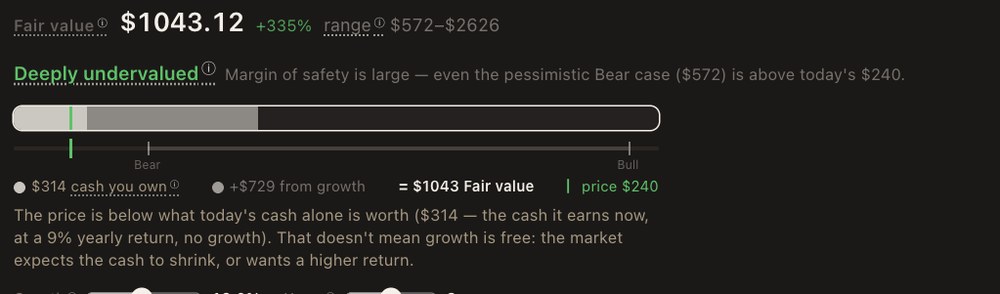
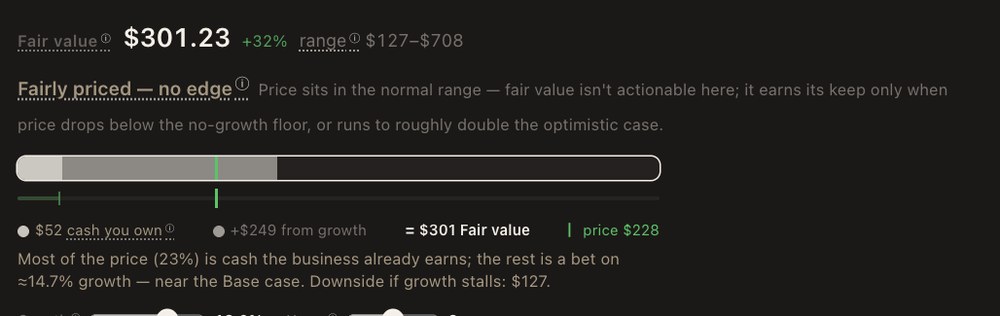
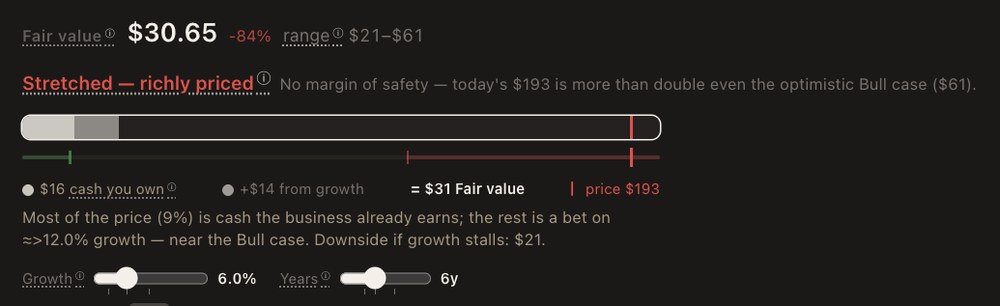
The verdict is the headline, not a buried number. Instead of a continuous “% upside” that quietly implies every gap matters, you get one of three honest readings — deeply undervalued, no edge, or stretched — because a fair-value estimate is only actionable when price is far enough from it that a margin of safety exists.
The two extremes aren’t symmetric — on purpose. Overvaluation can persist for years (manias don’t keep a schedule), so “stretched” only fires when price runs to roughly double even the optimistic case. Undervaluation is more actionable and bounded by the cash that already exists, so it triggers as soon as price slips below the no-growth floor. That mirrors the essay’s point: the real danger isn’t being wrong about value, it’s the leverage and the deadline — so the bar for calling enthusiasm overdone is set far higher than the bar for owning cash cheaply.
And the bar still shows the mix. Every reading splits the price into the cash you own now and the growth you’re betting on, with today’s price marked — so even in the “no edge” middle you can see, per dollar, how much of your thesis is investment and how much is speculation.
See any company’s fair value → A model estimate, not advice — the decision stays yours.
This essay is for education and general discussion. It is not investment advice, and nothing here is a recommendation to buy or sell any security. Companies are mentioned only to illustrate ideas. Do your own research; the decisions are yours.
价值投资
我们是否都只是投机者?
关于公允价值、现金,以及「拥有一门生意」与「押注一个价格」之间那条安静的界线。
打开任何一款投资应用,总有一个数字永不静止:价格。它每秒都在跳动,是数百万人竭尽全力、试图说出一家公司此刻值多少钱的集体结果。与这个鲜活、嗡嗡作响的数字相比,「公允价值」几乎显得有些古雅——一个缓慢的估算,每季度依据盈利、增长,以及一个同样在不断变动的折现率重新计算一次。
于是有一个公允却令人不安的问题。如果公允价值是一个会移动的估算,而价格是一个更快、流动性更强的估算,那么公允价值岂不只是同一样东西「反应更迟钝」的版本?果真如此的话——沃伦·巴菲特和一个交易员真有什么区别吗?世上究竟是否存在「价值投资者」这回事,还是说我们都只是换了套更体面说辞的投机者?
这个问题值得认真对待,因为它有一半恰恰说对了。
公允价值是一个估算,不是一个目标价
任何诚实的估值都是一个区间,而非市场笨到看不见的某个唯一正确的数字。它取决于种种假设——一家公司增长多快、能持续多久、您要求多少回报——理性的人会落在不同的位置。谁要是告诉您他算出了那个唯一正确的价格,他兜售的就是一种并不存在的确定性。所以没错:公允价值是一个会移动、不确定的估算。这一点,我们承认。
但「两者都在动」悄悄塞进了一个错误的等同。投资与投机之间的界线,从来不是价值固定、价格波动。它是另外两件完全不同的事。
您的回报从何而来
投机者的利润,来自下一个买家付出更高的价。其回报是别人将来的看法。投资者的回报,来自生意本身的现金——以股息派发的盈利、悄悄回购的股份、再投资以复利增长的现金。这一区别不是一种情绪,而是一种机制。
最清晰的看法是这样。取一家公司当前的现金生成能力,假设它一分钱都不再增长——只按您要求的回报率将其资本化。这就给出一个「无增长底价」:如果报价永远冻结、您只是收取现金,您能赚到的东西。无论明天市场开不开门,那份回报都存在。投机者没有任何对应之物——没有下一个买家,就根本没有回报。
价格告诉您人群愿意付多少。现金告诉您,您拥有的是什么。
一台投票机,一台称重机
公允价值和价格都会动——但动的幅度相差甚远,原因也截然不同。价值被现金流系住,缓慢漂移;价格则随情绪、流动性、杠杆与资金流向剧烈摆动。格雷厄姆那句老话依然成立:短期而言,市场是一台投票机;长期而言,它是一台称重机。
而「市场始终在尽其所能地评估」这话大体为真、也值得尊重——战胜它确实很难。但「尽力而为」并不等于「没有偏差」。被迫的卖家、追加保证金、赎回、投资授权的限制,以及纯粹的恐惧,经常把价格推离任何对价值的估算。倘若价格永远是价值的最佳估计,泡沫与恐慌便不可能发生——而它们照旧如期上演。价格是信息,而不是真理。
「安全边际难道不只是个借口?」
怀疑论最锋利的版本是这样的:安全边际是一种托辞。它承认即便您的分析更接近真相,市场也可以是「对的」——因为市场可以和您唱反调好几年,而没人能把市场说服。于是市场成了终极裁判,「价值」不过是一条安慰性的毛毯。
这抓住了一个真实的病症,却得出了错误的结论。病症确实存在:不少投资者用「市场先生不理性」来永不认错,在一门持续衰败的生意里坐上十年,还坚称它便宜。那是价值陷阱,无可辩护。一个从不接受任何检验的「价值」,一文不值。
但这个结论偷偷混淆了一件事。价格只裁判一件事——您今天能卖多少。它并不裁判您赚到了多少。这两者会分道扬镳,而一切都系于此。安全边际不是「市场对价值的判断也许是对的」。它是:我无法精确知道价值,也无法控制报价何时与我一致,所以我买得足够便宜,让这门生意无论报价如何都能回报我。
正因如此,「市场保持错误的时间,可以比您保持偿付能力的时间更长」,这是一句关于杠杆与期限的话,而非说价值是假的。拿掉借来的钱、拿掉那只钟,市场便无法靠闹脾气来否决一位耐心的所有者——您不会被迫卖出,于是您只管在它闹脾气的同时继续收取现金。而在足够长的时间尺度上,收敛不是一种期望,而是算术。一家持续产出真实每股现金的公司,不可能永远被无视——股息、回购,或一个收购方,终将把差距强行抹平。现金,对错误的价格具有腐蚀性。
诚实的记分牌不是「市场有没有转过弯来」,而是「现金有没有如期出现」。
这正是纪律化投资之所以可被证伪、而非一句借口的原因。如果您说某样东西便宜,而它既没有重新估值、也没有产出您所预测的现金,那您就是错了——记下来,然后翻篇。只有当您让现金、而非价格屏幕,来裁判您的论点时,这套纪律才真正奏效。
每一笔买入,都一半是投资、一半是投机
所以准确的说法并不是「我们都是投机者」。而是投资与投机处在一条光谱之上,而大多数自称投资者的人,比他们愿意承认的更靠近投机那一端。有用的做法,是别再纠缠于标签,而去衡量这个配比。
把任何价格拆成两部分:无增长底价——这门生意已经赚到、而您完全拥有的现金——以及其上的一切,那是对尚未发生的增长的押注。只付底价,您就是严格意义上的投资者。付得远高于底价,您论点的大部分便是一场增长押注——无论您用不用这个词,您都是披着价值外衣的投机者。两者都没有错。但您应当知道自己在做哪一种,以及您有多少钱押在了各自身上。
让您保持诚实的那道测验
有一个陷阱值得特别一提,因为谨慎的人正是栽在这上面。假设一只股票下跌了 40%,而上一季度的现金流毫无变化。这是天赐良机吗?未必。「基本面」并不等于过去的现金——一家公司的价值是其未来现金的价值,而对那个未来的可信威胁(一项新技术、一道正在开裂的护城河)确实会改变基本面,即便最新的报表看上去无恙。仅仅因为价格下跌、就依据过去的数字加仓,无异于盯着后视镜开车。
但这面镜子是双向的。一次就不可知的问题而发生的 40% 下跌,是人群当下的恐惧,而非远见——而在颠覆性的故事上,人群会反复地在两个方向上都犯错。所以无论是过去的现金、还是下跌的报价,都无法为此下定论。唯一诚实的做法是那个令人不适的做法:对未来现金的持久性形成一个判断,只有当价格即便对照悲观情形也便宜时才买入,并按您可能看错的概率来决定仓位大小。
那么,您是哪一种?
您可以投机。押注价格是一种正当的游戏,有些人玩得很好。危险的不是投机——而是一边投机、一边告诉自己这是投资,于是您永远不会察觉,自己为一个可能不会到来的未来付了多少钱。
解药既乏味又强大:在买入之前,把那道拆分讲清楚。这个价格里,有多少是生意已经赚到的现金,有多少是对增长的押注?今天的价格已经假定了怎样的增长——这门生意是否必须当个英雄,才配得上它?如果增长根本没来,您会损失什么?回答这些,标签自会归位。
TacticScale 如何呈现这一点——以及它何时真正重要
这正是 TacticScale 被打造出来、要让其变得可见的那道拆分——而同样重要的是,它会告诉您这道拆分何时值得据以行动。一个公允价值估算,只在极端处才真正有用:当价格被压到无增长底价之下,或被拉伸到远高于即便是乐观情形之时。在宽阔的中间地带,它会直言不讳——无明显优势——这正是本文所要谈的那份诚实的坦白。三个真实的读数:
判断就是标题,而不是一个被埋起来的数字。比起一个连续的「% 上行空间」——它悄悄暗示每一点差距都重要——您得到的是三种诚实读数之一:严重低估、无明显优势,或明显高估——因为只有当价格离公允价值足够远、以致存在安全边际时,这个估算才可据以行动。
两个极端并不对称——这是有意为之。高估可以持续数年(狂热从不按表作息),所以「明显高估」只有当价格冲到即便乐观情形的大约两倍时才触发。低估则更可据以行动,且被已经存在的现金所限定,所以只要价格滑到无增长底价之下便会触发。这呼应了本文的论点:真正的危险不在于看错价值,而在于杠杆与期限——因此,把热情判定为过度的门槛,被设得远高于便宜地拥有现金的门槛。
而条形图始终展示那个配比。每一个读数都把价格拆成您此刻拥有的现金,与您所押注的增长,并标出今天的价格——于是即便在「无明显优势」的中间地带,您也能看到:每一美元里,有多少是投资,有多少是投机。
查看任意公司的公允价值 → 一个模型估算,而非建议——决定权仍在您手中。
本文仅供教育与一般性讨论之用。它不构成投资建议,文中任何内容都不是买入或卖出任何证券的推荐。提及公司仅为阐明观点。请自行研究;决定由您自己作出。