 TacticScale
Companies · China
Futu: The Product I Wish I'd Built
As an engineer, very few products make me jealous. Futu's does — a Shenzhen broker that feels the way software is supposed to. A note on what I admire, and the discount the market has stamped on it.
I have spent most of my working life inside software — building it, breaking it, judging other people's. Very little of it makes me jealous. Futu's product does.
Let me be clear about what this note is. It's about why I like the company and the thing it makes — the craft, the economics, the sheer quality of the product. It is not a recommendation, not a price call, and — as you'll see — not a claim that the stock is a bargain, even though the screen says "deeply discounted." Those are different questions, and I'll get to why at the end.
The product an engineer envies
Futu (富途控股) runs two trading apps: Futubull (富途牛牛) for Hong Kong and Chinese-speaking investors, and moomoo for its international markets. On paper it is "an online broker." In the hand it is something rarer: a piece of software that feels like the people who built it actually trade, and actually care.
The charts are fast and dense. Quotes are real-time and don't stutter. Level-2 depth, options chains, filings, earnings, and a genuinely alive community all sit one tap away, laid out by someone with taste. It is the opposite of the clunky, decade-behind interfaces most brokers still ship. As an engineer, you can feel the discipline underneath — the latency budgets, the attention to the hundredth detail — and your honest reaction is: I wish I had built this.
That's not an accident of culture. Futu was founded in 2012 by Leaf Li (李华), one of Tencent's early engineers, and Tencent remains a major shareholder. The company carries Tencent's product DNA into a corner of finance that had almost none of it — and then exported it. From 2018, moomoo took that same quality to Singapore, the US, Australia, Japan, Canada and Malaysia.
A broker that feels like software built by people who use it. In this industry, that alone is a moat.
A Shenzhen company with software economics
A beautiful app is one thing. What made me actually sit up is the shape of the numbers underneath — because they don't look like a broker's. They look like software.
| Measure | Futu | What it says |
|---|---|---|
| Revenue growth | ≈ 47% / yr | Still compounding fast, not defending |
| Gross margin | ≈ 87% | Software economics, not a broker's |
| Net margin | ≈ 43% | Nearly half of revenue is profit |
| Free cash flow | ≈ 79% of sales | A cash machine |
| Return on equity | ≈ 28.4% | Capital compounds hard |
| Balance sheet | no net debt | Cash-rich, Tencent-backed |
| P/E | ≈ 10.8 | Priced like a business that won't grow |
| Dividend | ≈ 1.7% | Has started paying owners |
Read that top to bottom and the dissonance jumps out. An 87% gross margin and a 43% net margin belong to a SaaS company, not a brokerage. Revenue is still growing around half again each year, it converts most of that into cash, earns ~28% on equity, carries no net debt — and the market pays about 10.8 times earnings for it. Fast-growing software businesses do not usually trade at a no-growth multiple. Something is clearly weighing on it.
Why admiring a product isn't a price call
Here is the trap, and it's an easy one for anyone who loves a product to fall into.
Loving what a company makes tells you nothing, by itself, about whether its stock is a good buy today. A wonderful business bought at the wrong price is an ordinary investment — and, just as important, a wonderful business can be cheap for a reason that has nothing to do with the quality of the product. The two judgments live in different places:
This is the distinction the rest of this Journal keeps returning to. A price is not a property of a company; it forms where the company meets the market. So the right follow-up to "I'd have loved to build this" is not "therefore buy it" — it's "and what is the market already pricing in?"
What TacticScale actually says about the price
Here is where Futu gets genuinely interesting — and where TacticScale earns its keep by being honest in two directions at once:
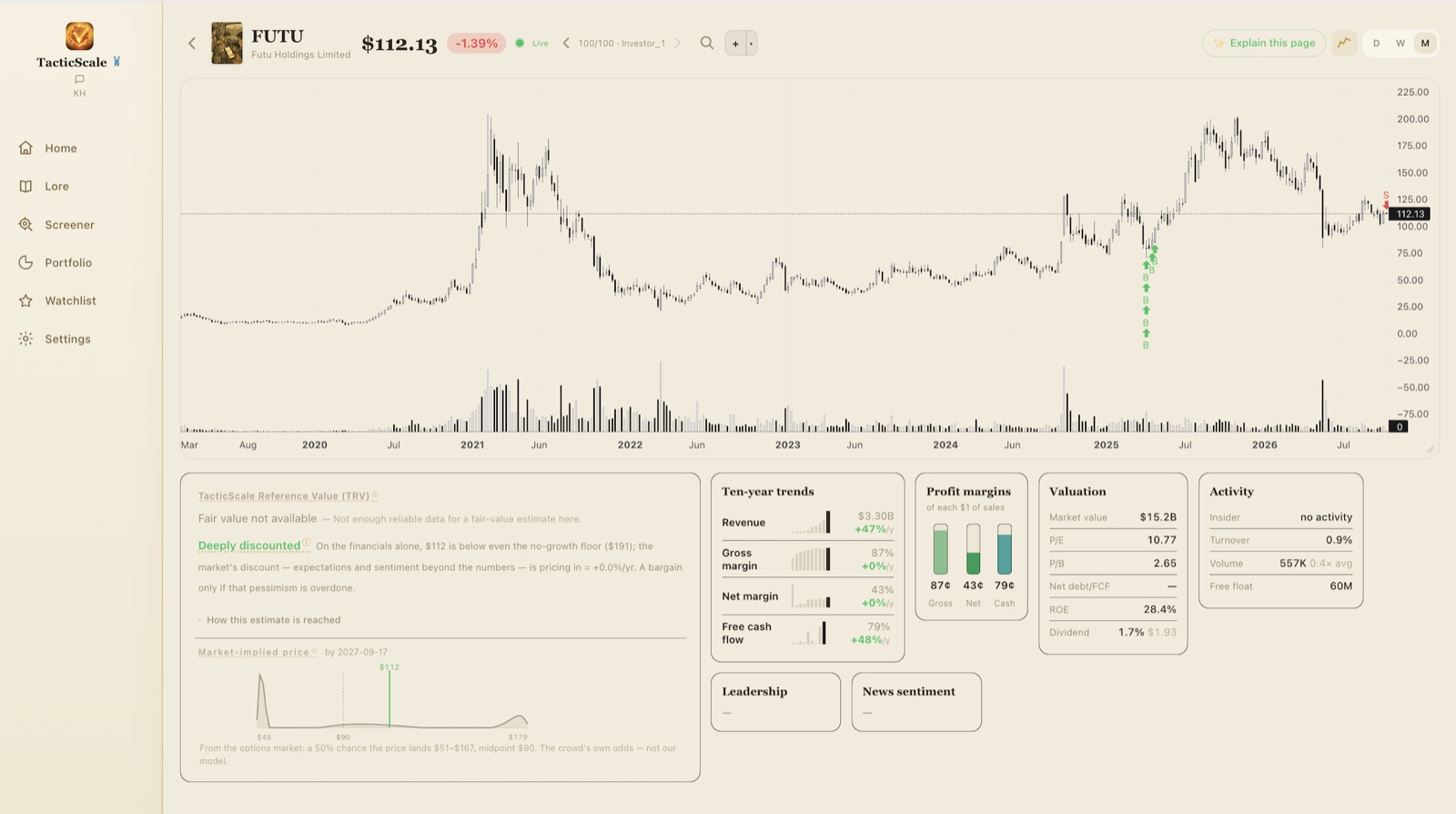
First, the honesty: TacticScale declines to compute a single fair value here — "not enough reliable data for a fair-value estimate." I like that it says so rather than inventing a confident number. Futu's cross-listed, HK-reported, fast-changing financials are exactly the kind of thing a deterministic model should be humble about.
Second, what it can say is blunt: on the reported financials alone, $112 sits below even the no-growth floor of $191 — the value of the business if growth simply stopped. By that measure it is Deeply discounted. But a discount that steep is never a free lunch. It is the market telling you it expects the numbers to get worse. The options market agrees: its own midpoint for next year is $90, below today's price — the crowd is assigning real probability to lower, not higher. As the panel puts it, a bargain only if that pessimism is overdone.
The discount has a name: May 2026
The gap between a wonderful product and a no-growth multiple isn't a mystery. It has a date.
In May 2026, China's securities regulator, the CSRC, proposed penalties totaling roughly RMB 1.85 billion (about US$271 million) on Futu, and pushed it to wind down its cross-border brokerage for mainland-China customers — part of a broader campaign that also hit Tiger and Longbridge. The stock fell about 27%. That is the cliff you can see on the chart, from near $200 down toward $75.
So the deep discount is not the market misreading a great business. It is the market pricing in a real, named event: the loss of Futu's mainland China customer base, and the ongoing regulatory risk of a Chinese-rooted broker operating across borders. The whole question, honestly stated, is whether moomoo's international growth — Singapore, the US, Japan, Australia and the rest — can more than replace what China takes away. If it can, today's price will look like fear. If it can't, the discount is deserved. I don't know which, and neither does the options market; that's what the $51–$167 range is telling you.
A deep discount is not a gift. It's the market naming a risk out loud.
So here is the honest whole of it. I admire Futu's product as much as any I've used, and as an engineer I'd have been proud to build it. The cheapness on the reported numbers is real. So is the risk the market is pricing. Admiring the company — even wishing I'd made it — is not the same as a verdict on the price. Both of those things are true at once, and holding them together without flinching is the entire point.
See it for yourself
TacticScale shows the reference value, the no-growth floor, and the market's own implied odds — and when it doesn't have enough reliable data to be confident, it tells you, instead of inventing a number.
This note describes a company and a product I admire, and the data behind them. It is not investment advice, a recommendation, or an offer to buy or sell any security. "Deeply discounted" is a methodological reading of price against a model floor, not a price target or a buy signal; a deep discount reflects risks the market is pricing, not guaranteed upside. Admiring a company is not a reason to own its stock. Do your own work.
公司 · 中国
富途牛牛:我多希望这是我做出来的产品
作为一名工程师,很少有产品能让我嫉妒。富途做到了——一家深圳券商,做出了软件本该有的样子。这篇短文谈谈我欣赏它什么,以及市场在它身上盖下的那道折价。
我大半的职业生涯都泡在软件里——做它、拆它、评判别人做的。很少有东西能让我嫉妒。富途的产品做到了。
我想先把这篇短文的性质说清楚。它谈的是我为什么喜欢这家公司,以及它做出来的那个东西——那份手艺、那套经济模型、那种纯粹的产品质量。它不是推荐,不是对价格的判断,而且——您往下读就会看到——也不是在说这只股票便宜,哪怕界面上写着"深度折价"。这些是不同的问题,文末我会回到这一点。
一个让工程师嫉妒的产品
富途控股运营着两款交易应用:面向香港与华语投资者的 富途牛牛,以及面向国际市场的 moomoo。纸面上,它是"一家互联网券商"。但拿在手里,它是更稀有的东西:一款让你觉得"做它的人自己真的在交易、也真的在乎"的软件。
图表又快又密。行情是实时的,不卡顿。Level-2 盘口、期权链、财报、公告,还有一个真正鲜活的社区,全都在一键之遥,被一个有品味的人仔细排布过。它和大多数券商至今还在用的、落后十年的笨重界面,恰好相反。作为工程师,您能感受到底层的那份克制——延迟预算、对第一百个细节的较真——而您诚实的反应会是:我真希望这是我做出来的。
这并不是偶然的文化。富途由李华于 2012 年创立,他是腾讯早期的工程师之一,而腾讯至今仍是其重要股东。这家公司把腾讯的产品基因,带进了一个几乎没有这种基因的金融角落——然后又把它出口到了海外。从 2018 年起,moomoo 把同样的质量带到了新加坡、美国、澳大利亚、日本、加拿大和马来西亚。
一家做得像"自己人用的软件"一样的券商。在这个行业里,光这一点就是护城河。
一家拥有软件经济学的深圳公司
漂亮的 App 是一回事。真正让我坐直身子的,是它底层那组数字的形状——因为它们不像一家券商,倒像一家软件公司。
| 指标 | 富途 | 它说明了什么 |
|---|---|---|
| 营收增长 | ≈ 47% / 年 | 仍在高速复利,而非守成 |
| 毛利率 | ≈ 87% | 是软件的经济学,不是券商的 |
| 净利率 | ≈ 43% | 近一半的收入是利润 |
| 自由现金流 | ≈ 营收的 79% | 一台现金机器 |
| 净资产收益率 | ≈ 28.4% | 资本在高强度复利 |
| 资产负债表 | 无净负债 | 现金充裕、腾讯持股 |
| 市盈率 | ≈ 10.8 | 被定成一门不会增长的生意 |
| 股息率 | ≈ 1.7% | 已经开始向股东分红 |
从上往下读,那股违和感会跳出来。87% 的毛利率、43% 的净利率,属于一家 SaaS 公司,而不是一家券商。营收每年还在增长约一半,又把其中大部分转化为现金,净资产收益率约 28%,没有净负债——而市场只愿意为它付大约 10.8 倍的市盈率。高速增长的软件生意,通常不会以"零增长"的估值交易。显然,有什么东西在压着它。
为什么欣赏一个产品,不等于对价格下判断
这里有一个陷阱,而且是任何热爱某个产品的人都很容易掉进去的。
热爱一家公司做出来的东西,本身并不能告诉您它的股票今天是不是一笔好买卖。一门优秀的生意,若买在错误的价格上,也只是一笔平庸的投资——而同样重要的是,一门优秀的生意之所以便宜,原因可能和产品的好坏毫无关系。这两个判断,住在不同的地方:
这正是本专栏反复回到的那个区分。价格不是公司的固有属性;它形成于公司与市场相遇之处。所以,"我真希望这是我做出来的"之后,正确的追问不是"所以买它"——而是"那么市场已经把什么计入价格了?"
TacticScale 对这个价格到底怎么说
这正是富途真正有意思的地方——也是 TacticScale 靠"同时朝两个方向诚实"而体现价值的地方:
先说那份诚实:TacticScale 在这里拒绝算出一个单一的公允价值——「可靠数据不足,无法给出公允价值估计」。我喜欢它把这句话说出来,而不是硬造一个看似笃定的数字。富途那套跨市场上市、以港元披露、又在快速变化的财务数据,恰恰是一个确定性模型应当保持谦逊的对象。
再说它能说的,很直接:仅就已披露的财报而言,112 美元落在连 191 美元的零增长底线都不到的位置——也就是假如增长彻底停滞、这门生意还值的那个数。按这个尺度,它是深度折价的。但如此陡峭的折价,从来不是免费的午餐。它是市场在告诉您:它预期这些数字会变得更糟。期权市场也同意:它对明年的中值是 90 美元,低于今天的股价——人群把实实在在的概率,押在了更低、而不是更高的价格上。正如面板所言:只有当这份悲观被过度定价时,它才是便宜货。
这个折价有个名字:2026 年 5 月
一个出色的产品与一个"零增长"的估值之间的鸿沟,并不神秘。它有一个日期。
在 2026 年 5 月,中国证监会(CSRC)对富途提出了合计约 18.5 亿元人民币(约 2.71 亿美元)的拟处罚,并推动其清退面向中国内地客户的跨境经纪业务——这是一场更大范围整治的一部分,老虎、长桥也同样被波及。股价下跌了约 27%。这就是您在图上看到的那道悬崖,从接近 200 美元跌向 75 美元一线。
所以这道深度折价,并不是市场错读了一门好生意。它是市场在为一个真实的、有名有姓的事件定价:富途失去中国内地的客户基础,以及一家中国根源的券商在跨境经营中持续面临的监管风险。诚实地说,全部问题只在于:moomoo 的国际增长——新加坡、美国、日本、澳大利亚等等——能不能不止是补上、而是超过中国所拿走的那一块。如果能,今天的价格事后看就是恐惧;如果不能,这道折价就是应得的。我不知道答案,期权市场也不知道;那条 51 到 167 美元的区间,说的正是这件事。
深度折价不是一份礼物。它是市场把一个风险,大声念了出来。
所以,诚实的全貌是这样的。我欣赏富途的产品,不亚于我用过的任何一个;作为工程师,能做出它我会很自豪。已披露数字上的便宜,是真的。市场正在定价的风险,也是真的。欣赏这家公司——哪怕希望它是我做出来的——并不等同于对价格下的判断。这两件事可以同时为真,而毫不回避地把它们一起捧在手里,正是全部的意义所在。
亲自去看一看
TacticScale 会展示参考价值、零增长底线,以及市场自己隐含的概率——而当它没有足够可靠的数据、无法做到笃定时,它会直接告诉您,而不是硬造一个数字。
这篇短文描述的是一家我欣赏的公司与产品,以及它们背后的数据。它不构成投资建议、推荐,也不构成对任何证券的买卖要约。「深度折价」是把价格与模型底线相比得出的一个方法论读数,而非目标价或买入信号;深度折价反映的是市场正在定价的风险,而非确定的上涨空间。欣赏一家公司,并不是持有其股票的理由。请自行研究。