 TacticScale
Companies · China
Why I Like Eastroc Beverage
One drink built one of the highest-return consumer businesses in China. A note on what makes it admirable — and why admiring a business is a different thing from a verdict on its price.
Eastroc Beverage (东鹏饮料, 605499.SS) sells, more or less, one product: an energy drink in a yellow plastic bottle with a gold cap. From that single idea it has built a business most companies with a dozen products never reach.
I want to be clear about what this note is and isn’t. It is a note about why I like the business — the economics, the discipline, the shape of the numbers. It is not a recommendation, not a price call, and not a claim that the stock is cheap today. Those are separate questions, and I’ll come back to why at the end.
One bottle, a very good business
Dongpeng Special Drink started as a value challenger to Red Bull in China — a near-identical functional drink at a lower price, sold first to the people who actually need caffeine to get through a shift: truck drivers, factory workers, delivery riders, students. Over the past decade it has gone from a regional southern brand to the No.1 energy drink in China by volume — overtaking Red Bull, the very incumbent it set out to undercut.
The strategy is almost boringly simple: one hero product, relentless distribution, a price point that undercuts the incumbent, and point-of-sale presence in millions of small shops. Simple, but very hard to copy at scale — and the financial result is what first caught my eye.
There is a famous precedent for a business shaped like this. Coca-Cola is, stripped down, a single sweet and lightly caffeinated drink that gives people a small lift — sold cheaply, sold everywhere, and bought again the next day. From that one idea it became one of the greatest consumer franchises in history, and Warren Buffett’s favourite holding for good reason: a simple, mildly energising drink, endlessly repeatable, is a remarkably durable machine. Eastroc is running a recognisable version of that playbook in China’s energy-drink aisle — a different formula and a different country, but much the same underlying economics.
| Measure | Eastroc | What it says |
|---|---|---|
| Revenue growth | ≈ 35% / yr | Still taking share, not defending it |
| Gross margin | ≈ 47% | Real pricing power for a value brand |
| Net margin | ≈ 22% | Growth that drops to the bottom line |
| Free cash flow | ≈ 18% of sales | Profit you can actually bank |
| Return on equity | ≈ 34.7% | Capital compounds hard |
| Net cash | ≈ ¥17.2B | No debt doing the heavy lifting |
| Dividend yield | ≈ 4.3% | Growth that still pays you to wait |
Read those together and a picture forms. This is not a company borrowing money to buy growth, nor one trading margin for volume. It is growing revenue by about a third a year while keeping a ~47% gross margin, converting roughly a fifth of sales into cash, carrying no net debt, and still returning cash to owners. That combination — fast growth, high returns on capital, real cash generation, a fortress balance sheet — is rare anywhere, and rarer still in a single-product consumer company.
What I actually admire
Numbers are the evidence; they aren’t the reason. What I admire is the discipline behind them.
A company that has one product and does it exceptionally well has made a choice most can’t resist unmaking. The easy move, once the cash arrives, is to sprawl — into dozens of SKUs, unrelated categories, acquisitions that flatter revenue and quietly wreck returns on capital. Eastroc has mostly resisted that. It extends carefully, from an obvious position of strength, and keeps the core franchise doing the heavy lifting.
The hardest thing for a successful company is to keep doing the one thing it is great at.
There is also honesty in who the customer is. This is not an aspirational lifestyle brand selling an image. It sells function to people who are tired and need to keep going, at a price they’ll pay again tomorrow. That kind of repeat, need-based consumption is exactly the demand a durable consumer business is built on.
Why liking the business is not a price call
Here is the part that matters most, and the part a lot of writing on “great companies” skips.
Admiring a business tells you nothing, on its own, about whether its stock is a good buy today. A wonderful company bought at the wrong price is an ordinary investment. Coca-Cola in 1998 is the classic warning: the same one-drink franchise above, a magnificent business — yet priced near 50 times earnings, after which the stock went roughly nowhere for more than a decade while the company itself kept growing. The quality was real; it was simply already, and then some, in the price. The two judgments live in different places:
This is the distinction the rest of this Journal keeps returning to. A price is not a property of a company; it forms where the company meets the market. So the right follow-up to “I like this business” is not “therefore buy it” — it’s “and what is the market already asking me to pay for it?”
What TacticScale actually says about the price
Inside TacticScale, Eastroc carries a TacticScale Reference Value (TRV) — a deterministic, owner-earnings reference anchored to the reported financials, not a target and not advice. Here is the actual view:
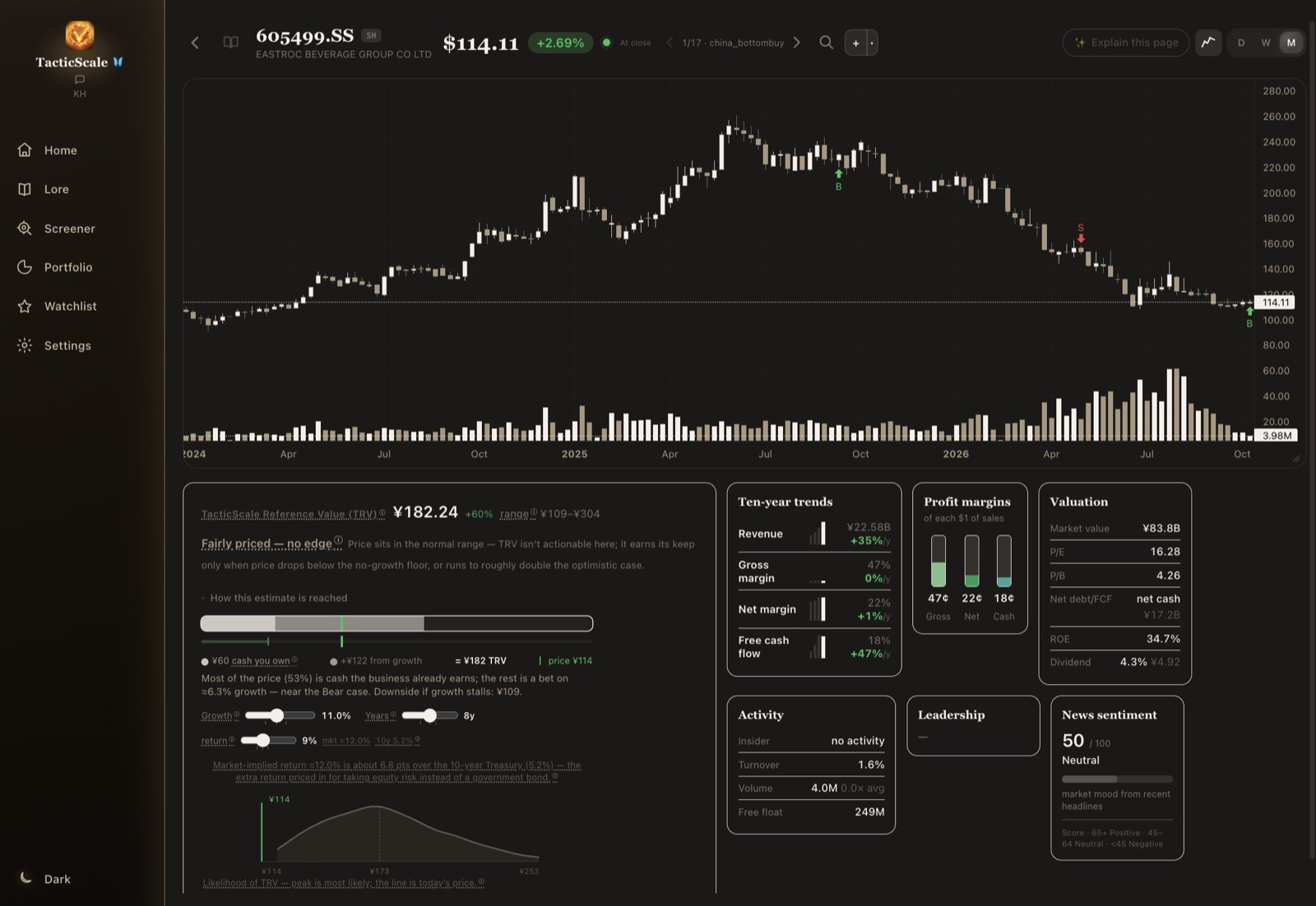
Look closely, because this is the interesting part. The reference value sits about 60% above today’s price. On plenty of screens a gap like that would flash as a screaming bargain. TacticScale doesn’t. Its verdict stays deliberately quiet:
Fairly priced — no edge.
The reason is the whole discipline in one line: a price is only actionable at the extremes. The stock has already fallen a long way from its highs, and at ¥114 it sits just above the model’s no-growth floor of ¥109 — what the business is worth if growth simply stopped. About 53% of today’s price is cash the company already earns; the rest is a modest bet on ≈6.3% growth, near the bearish end of the range. TRV only earns its keep when price slips below that floor, or runs up toward roughly double the optimistic case (~¥304). In the broad middle, it stays silent.
So the honest reading is neither “cheap” nor “expensive.” It is: a very good business, priced where the market can see it plainly, with no clear edge for a buyer today. I like the business. The tool declines to pretend that liking it — or even a 60% gap to a reference value — is the same as a margin of safety. Both of those things are true at once, and holding them together honestly is the whole point.
See it for yourself
TacticScale shows the Reference Value as a build-up bar with a plain verdict — bargain, fairly priced, or richly priced — so you can see not just a number but whether the number is even worth acting on.
This note describes a business I find admirable and the data behind it. It is not investment advice, a recommendation, or an offer to buy or sell any security. The TacticScale Reference Value is a methodological reference, not a price target. Admiring a company is not a reason to own its stock. Do your own work.
公司 · 中国
为什么我喜欢东鹏饮料
一款饮料,撑起了中国回报率最高的消费企业之一。这篇短文谈谈它值得欣赏之处——以及为什么"欣赏一门生意"与"对它的价格下判断"是两回事。
东鹏饮料(605499.SS)几乎只卖一样东西:一瓶装在黄色塑料瓶里、拧着金色瓶盖的能量饮料。就凭这一个点子,它做成了许多拥有十几款产品的公司都未必能做到的生意。
我想先把这篇短文的性质说清楚。它谈的是我为什么喜欢这门生意——它的经济特征、它的克制、它那组数字的形状。它不是推荐,不是对价格的判断,也不是在说这只股票今天便宜。那些是另外的问题,文末我会回到这一点。
一瓶饮料,一门很好的生意
东鹏特饮最初是红牛在中国的性价比挑战者——一款几乎相同的功能饮料,卖得更便宜,首先卖给那些真正需要靠咖啡因撑过一个班次的人:货车司机、工厂工人、外卖骑手、学生。过去十年里,它从华南的一个区域品牌,做到了中国能量饮料市场销量第一——超越了它当初要去挑战的那个在位者红牛。
它的打法简单得近乎乏味:一款核心大单品、不留余力的渠道铺货、低于在位者的价格、以及在数百万家小店里的终端陈列。简单,但要在这个规模上复制却非常难——而真正先吸引我的,是它的财务结果。
这样形态的生意,其实早有一个著名的先例。可口可乐,剥到最里层,不过是一款甜的、带少许咖啡因、能让人提一点神的饮料——卖得便宜、卖得到处都是、第二天还会再被买一次。就凭这一个点子,它成长为历史上最伟大的消费品特许经营之一,也成了巴菲特最钟爱的持仓——理由很充分:一款简单、能让人微微提神、可以无限重复消费的饮料,是一台异常耐用的机器。东鹏在中国的能量饮料货架上,跑的正是这套打法一个似曾相识的版本——配方不同、国家不同,但底层的经济学大体一致。
| 指标 | 东鹏 | 它说明了什么 |
|---|---|---|
| 营收增长 | ≈ 35% / 年 | 仍在抢占份额,而非守成 |
| 毛利率 | ≈ 47% | 一个性价比品牌拥有真实定价权 |
| 净利率 | ≈ 22% | 增长能够落到利润上 |
| 自由现金流 | ≈ 营收的 18% | 能真正收进口袋的利润 |
| 净资产收益率 | ≈ 34.7% | 资本在高强度复利 |
| 净现金 | ≈ 172 亿元 | 增长不靠加杠杆 |
| 股息率 | ≈ 4.3% | 成长股还愿意付钱让你等待 |
把这些放在一起看,一幅图景就浮现了。这不是一家靠借钱买增长的公司,也不是一家牺牲利润换销量的公司。它每年把营收做大约三分之一,同时还维持着约 47% 的毛利率,把近五分之一的收入转化为现金,没有净负债,并且仍在向股东分红。这种组合——快速增长、高资本回报、真实的现金产出、堡垒般的资产负债表——在任何地方都很少见,在一家单品类消费公司身上就更罕见。
我真正欣赏的是什么
数字只是证据,它们并不是理由。我真正欣赏的,是数字背后的那份克制。
一家只做一款产品、并且做到极致的公司,其实是做出了一个大多数人忍不住要推翻的选择。现金一旦进来,最容易的动作就是扩张——铺开几十个 SKU、进入不相关的品类、做那些让营收好看、却悄悄毁掉资本回报的并购。东鹏大体上抵住了这种诱惑。它从明显的优势位置出发、谨慎地做延展,让核心品牌继续挑大梁。
对一家成功的公司来说,最难的,是继续只做那件它最擅长的事。
在"客户是谁"这件事上,它也足够诚实。这不是一个贩卖形象、贩卖理想生活方式的品牌。它把功能卖给那些疲惫、却必须继续撑下去的人,卖的是一个他们明天还愿意再掏一次的价格。这种基于真实需求的重复消费,正是一门耐用消费生意赖以立足的那种需求。
为什么"喜欢这门生意"不等于"对价格下判断"
接下来这一段最关键,也是很多谈论"伟大公司"的文章会跳过的地方。
欣赏一门生意,本身并不能告诉你它的股票今天是不是一笔好买卖。一家优秀的公司,若买在错误的价格上,也只是一笔平庸的投资。1998 年的可口可乐就是那个经典的警示:同样是上面那门「一款饮料」的伟大生意,却被定在了近 50 倍市盈率上,此后十余年里股价几乎原地踏步,而公司本身仍在不断成长。那份优秀是真的;只是它早已——而且还多出一截——被计入了价格。这两个判断,住在不同的地方:
这正是本专栏反复回到的那个区分。价格不是公司的固有属性;它形成于公司与市场相遇之处。所以,"我喜欢这门生意"之后,正确的追问不是"所以买它"——而是"那么市场已经在要我为它付多少?"
TacticScale 对这个价格到底怎么说
在 TacticScale 里,东鹏带有一个 TacticScale 参考价值(TRV)——一个基于所有者收益、锚定在已披露财报上的确定性参考值,它既不是目标价,也不是建议。下面就是实际的界面:
请仔细看,因为最有意思的正是这一点。参考价值比今天的股价高出约 60%。在很多软件上,这样的差距会被亮成一个"尖叫着的便宜货"。TacticScale 不会。它的结论刻意保持安静:
价格合理——没有胜算。
原因,就是整套纪律的那一句话:价格只有在极端处才值得据此行动。这只股票已经从高位跌下来很长一段,¥114 的价格恰好落在模型的零增长底线 ¥109 之上一点——也就是假如增长彻底停滞、这门生意还值的那个数。今天付出的价格里,约 53% 是公司已经在赚的现金;其余部分,只是对约 6.3% 增长的一个温和下注,接近区间偏悲观的一端。只有当价格跌破那条底线,或者一路涨到大约乐观情形的两倍(约 ¥304)时,TRV 才真正派上用场。在中间那片宽阔的地带,它保持沉默。
所以诚实的解读既不是"便宜",也不是"贵"。而是:一门很好的生意,被定在一个市场看得很清楚的价格上,今天对买家而言并没有明显的胜算。我喜欢这门生意。而这个工具拒绝假装——喜欢它、甚至与参考价值相差 60%——就等同于拥有了安全边际。这两件事可以同时为真,而诚实地把它们一起捧在手里,正是全部的意义所在。
亲自去看一看
TacticScale 把参考价值显示为一根价值累加条,配上一句朴素的结论——便宜、价格合理、还是偏贵——这样你看到的就不只是一个数字,而是这个数字到底值不值得你据此行动。
这篇短文描述的是一门我认为值得欣赏的生意,以及它背后的数据。它不构成投资建议、推荐,也不构成对任何证券的买卖要约。TacticScale 参考价值是一个方法论意义上的参考值,而非目标价。欣赏一家公司,并不是持有其股票的理由。请自行研究。